
Access and vehicle
Confirm the entrance, road condition, vehicle type and whether ranger or guide support is required for your planned route.
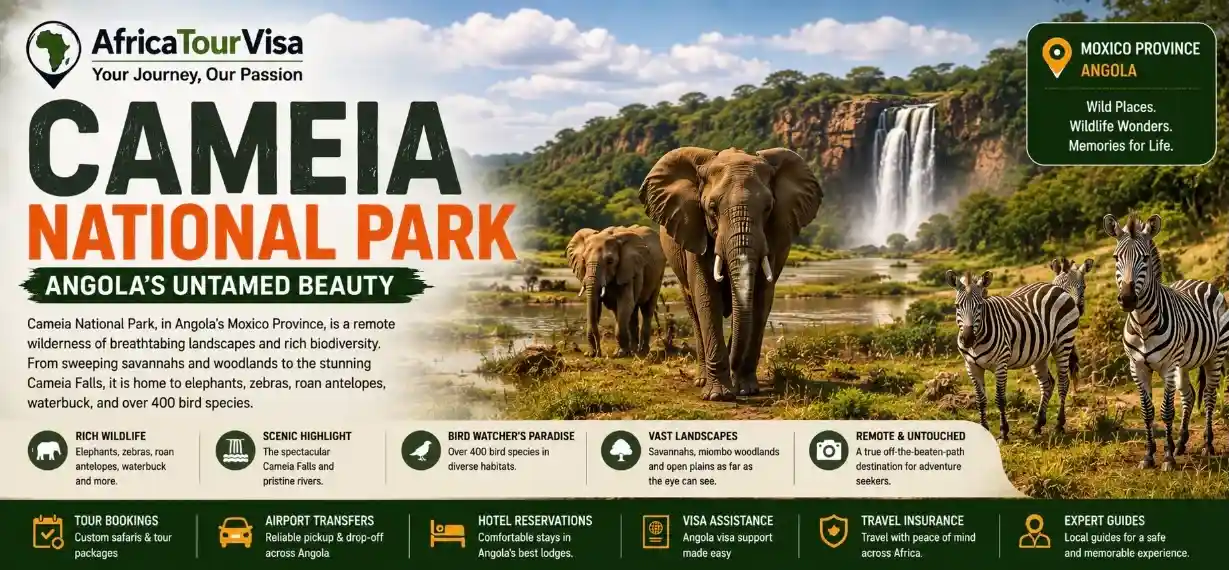
Cameia’s broad seasonal wetlands are not background scenery; they are the ecological engine of the park. Water levels can transform open plains into flooded habitat, influencing animal distribution, birdlife and which tracks remain usable.
INBAC’s current park profile lists antelope and other mammals associated with the floodplain environment, as well as hippopotamus and large carnivores in the park’s recorded fauna. Treat those lists as conservation records, not promises of what a short visitor will see.
The practical gateway is Luena and eastern Angola, not the capital. Build time for local transport, fuel, communications and a buffer for road conditions. Cameia fits an eastern expedition far better than a short Luanda itinerary.
Flooding is part of the ecosystem, so access can change with rainfall and water levels. Before departure, ask the responsible authority or local operator about current tracks, river crossings, vehicle needs and whether planned areas are open.
Cameia is strongest for travelers interested in landscape, birds, wetland systems and the experience of remote eastern Angola. It is not a destination where a rigid minute-by-minute safari schedule is helpful; flexibility is a practical asset.
Practical preparation
Visitor infrastructure and access conditions vary across Angola’s protected areas. Confirm current arrangements rather than relying on old safari descriptions.
Confirm the entrance, road condition, vehicle type and whether ranger or guide support is required for your planned route.
Check where the last reliable fuel, food, water and overnight services are located. Remote park travel should not depend on finding supplies after arrival.
Review whether your travel insurance covers remote road travel and evacuation, and carry an appropriate communications plan for areas with weak mobile coverage.
Angola entry planning
National park access does not replace Angola’s immigration requirements. Check the entry route for your passport, purpose of travel, intended stay and number of entries before paying for non-refundable arrangements. Tourism permission should not be treated as authorization for employment, journalism, filming or technical work where separate approval is required.
Travel assistance
AfricaTourVisa is an independent travel and visa-assistance service. We do not manage Cameia National Park and cannot guarantee park admission or wildlife sightings. We help travelers connect entry preparation with hotels, airport pickup, insurance and practical route planning.
Continue exploring
Compare this park with Cameia National Park before fixing the wider Angola route.
Compare this park with Cameia National Park before fixing the wider Angola route.
Compare this park with Cameia National Park before fixing the wider Angola route.
Official-source review
This guide uses Angola’s National Institute for Biodiversity and Conservation Areas (INBAC) as the primary authority for park status, location and protected-area information. For Iona and current restoration work, African Parks is also used where relevant. Opening arrangements, fees, road access and visitor services can change, so verify them close to departure.
Last reviewed: .
INBAC places Cameia in eastern Angola, about 125 km from Luena.
The official INBAC profile gives an area of about 14,450 km².
Its extensive periodically flooded plains and wetland ecology distinguish it from Angola’s desert, coastal and dry-savanna parks.