
Access and vehicle
Confirm the entrance, road condition, vehicle type and whether ranger or guide support is required for your planned route.
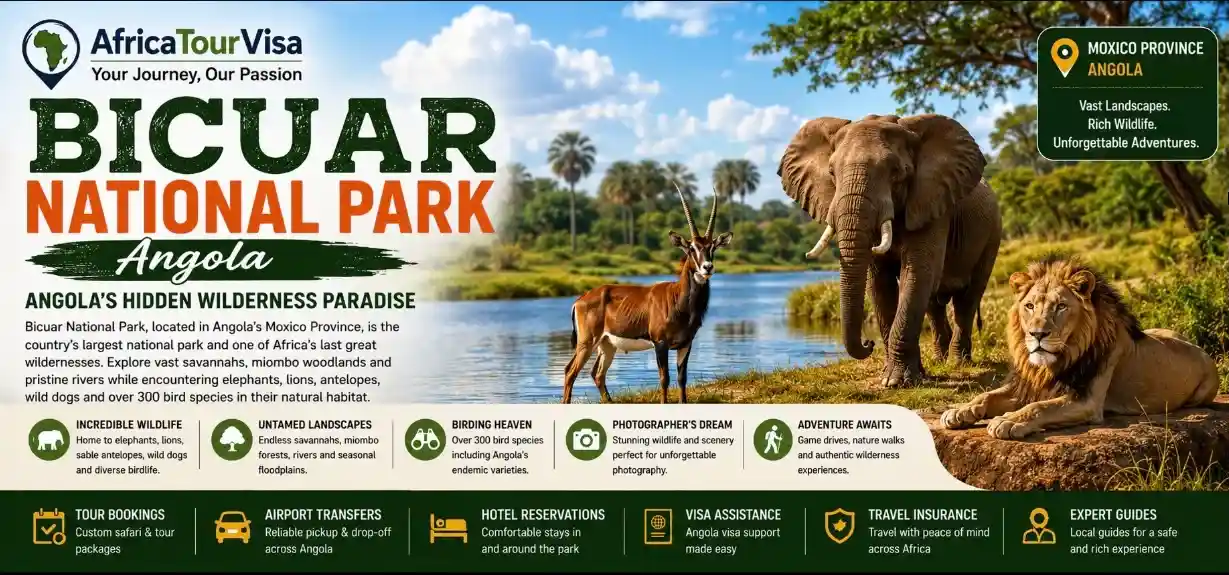
Bicuar sits near the transition between miombo-influenced woodland and drier southern vegetation. INBAC describes dry forest, tree-and-shrub savanna, grassland openings, steppe-like areas and pockets of wet habitat. That diversity means a visit is as much about reading the landscape as searching for animals.
Official conservation reporting identifies elephants as an important population in Bicuar and also records threatened species such as African wild dog and leopard. Sightings should never be presented as guaranteed: the park is large, wildlife densities vary, and local guide knowledge matters greatly.
Lubango gives travelers the strongest service base for a Bicuar trip: accommodation, fuel, supplies and transport can be arranged before leaving the city. A sensible southern itinerary can combine Bicuar with Tundavala, Serra da Leba and the wider Huíla landscape rather than forcing a return to Luanda between experiences.
A map distance does not tell the whole story. Travelers should confirm road condition, entrance arrangements, seasonal access and vehicle requirements shortly before travel. For first-time visitors, a locally experienced driver or guide is a stronger choice than assuming a standard rental car can handle all routes.
Bicuar is better suited to travelers who value low-density wilderness, conservation context and regional exploration than those expecting the highly serviced game-drive circuits found elsewhere in southern Africa. The reward is a more exploratory experience, but it requires realistic preparation.
Practical preparation
Visitor infrastructure and access conditions vary across Angola’s protected areas. Confirm current arrangements rather than relying on old safari descriptions.
Confirm the entrance, road condition, vehicle type and whether ranger or guide support is required for your planned route.
Check where the last reliable fuel, food, water and overnight services are located. Remote park travel should not depend on finding supplies after arrival.
Review whether your travel insurance covers remote road travel and evacuation, and carry an appropriate communications plan for areas with weak mobile coverage.
Angola entry planning
National park access does not replace Angola’s immigration requirements. Check the entry route for your passport, purpose of travel, intended stay and number of entries before paying for non-refundable arrangements. Tourism permission should not be treated as authorization for employment, journalism, filming or technical work where separate approval is required.
Travel assistance
AfricaTourVisa is an independent travel and visa-assistance service. We do not manage Bicuar National Park and cannot guarantee park admission or wildlife sightings. We help travelers connect entry preparation with hotels, airport pickup, insurance and practical route planning.
Continue exploring
Compare this park with Bicuar National Park before fixing the wider Angola route.
Compare this park with Bicuar National Park before fixing the wider Angola route.
Compare this park with Bicuar National Park before fixing the wider Angola route.
Official-source review
This guide uses Angola’s National Institute for Biodiversity and Conservation Areas (INBAC) as the primary authority for park status, location and protected-area information. For Iona and current restoration work, African Parks is also used where relevant. Opening arrangements, fees, road access and visitor services can change, so verify them close to departure.
Last reviewed: .
INBAC places Bicuar National Park about 165 km from Lubango. Driving time depends on the route and current road conditions.
Official conservation material records elephants and threatened species including African wild dog and leopard, alongside other savanna and woodland fauna. Sightings are not guaranteed.
Vehicle requirements depend on current road and park conditions. Confirm locally before travel; a high-clearance 4×4 and experienced driver may be appropriate for remote routes.